
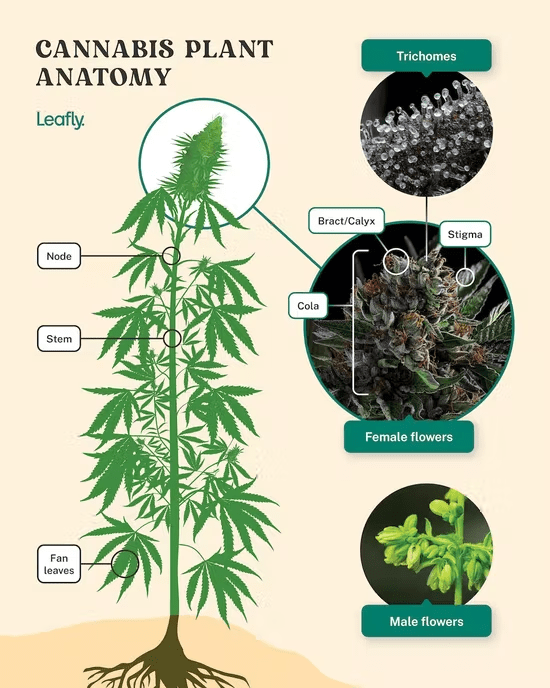
Image from [Leafly.com]
Aeroponics is the process of cultivating plants in an air or mist environment, eliminating the need for soil or an aggregate medium.
The fundamental principle of aeroponic growing entails suspending plants in a closed or semi-closed environment while spraying their dangling roots and lower stems with a nutrient-rich water solution in an atomized or sprayed form.
A bract is a modified or specialized leaf, especially one associated with a reproductive structure such as a flower, inflorescence axis or cone scale. Bracts are usually different from foliage leaves. They may be smaller, larger, or of a different color, shape, or texture. Typically, they also look different from the parts of the flower, such as the petals or sepals. (Wiki)
Cannabinoids are several structural classes of compounds found in the trichomes produced by the cannabis plant. The most notable cannabinoid is the phytocannabinoid tetrahydrocannabinol (THC) (delta-9-THC), the primary intoxicating compound in cannabis. Cannabidiol (CBD) is a major constituent of indica dominant cannabis plants and a minor constituent in the tropical, sativa dominant varieties. At least 113 distinct phytocannabinoids have been isolated from cannabis, although only four (i.e., THCA, CBDA, CBCA and their common precursor CBGA) have been demonstrated to have a biogenetic, meaning actually created by the plant, origin.
Cola: Colas are clusters of buds that grow tightly together on female cannabis plants. They can be large or small, and light exposure typically affects the size of colas—large colas usually grow at the top of the plant or the end of branches, which receive more light, and smaller colas are usually found on lower branches, which typically receive less light. (leafly.com)
Deep water culture (DWC) is a hydroponic method of plant production by means of suspending the plant roots in a solution of nutrient-rich, oxygenated water.
Flushing: Flushing is when you stop giving a marijuana plant nutrients and give it straight water. This is done in the last week of flowering because people believe it will flush out nutrients that may have built up in a plant during its life. A very well done study has shown that flushing has no affect on the chemical composition of the plant The Atruim. For an interesting look into this research go here. Another look at flushing in High Times.
Infusion: Infusion in the context of cannabis refers to the process of extracting cannabinoids and other beneficial compounds from the plant and infusing them into different products. This can be done by using various methods such as heat, solvents, or pressure to extract the desired components. The extracted compounds are then added to products like edibles, topicals, or beverages to provide the desired effects. Infused cannabis products offer an alternative consumption method for those who prefer not to smoke or vape. They allow for precise dosing and provide a longer-lasting and more controlled experience. Infusion has become popular in the cannabis industry as it allows for the creation of a wide range of products with different potency levels and flavors. The Herb Lifestyle
Internode: (Science: plant biology) The portion of a stem between the level of insertion of two successive leaves or leaf pairs (or branches of an inflorescence). A segment of a stem between two nodes. The portion of stem found between lateral meristems in plants. (BiologyOnline.com
pH, denoting ‘potential of hydrogen’ or ‘power of hydrogen’ is a scale used to specify the acidity or basicity of an aqueous solution. Acidic solutions (solutions with higher concentrations of H+ ions) are measured to have lower pH values than basic or alkaline solutions.
The pH scale is logarithmic and inversely indicates the concentration of hydrogen ions in the solution. This is because the formula used to calculate pH approximates the negative of the base 10 logarithm of the molar concentration of hydrogen ions in the solution. More precisely, pH is the negative of the base 10 logarithm of the activity of the H+ ion.
At 25 °C, solutions with a pH less than 7 are acidic, and solutions with a pH greater than 7 are basic. Solutions with a pH of 7 at this temperature are neutral (e.g. pure water). The neutral value of the pH depends on the temperature – being lower than 7 if the temperature increases. The pH value can be less than 0 for very strong acids, or greater than 14 for very strong bases. (Wikipedia)
Node: A plant node refers to a crucial part of a plant’s stem where a leaf or multiple leaves attach. It serves as a connection point between the stem and the leaves, allowing for various functions such as transportation of water and nutrients, photosynthesis, nutrient storage, reproduction, and propagation. Nodes are important anatomical features that play a significant role in the growth and development of plants.
Phenotype: (var. phenotypical, phenotypic) In genetics, the phenotype is the set of observable characteristics or traits of an organism. The term covers the organism’s morphology (physical form and structure), its developmental processes, its biochemical and physiological properties, its behavior, and the products of behavior. An organism’s phenotype results from two basic factors: the expression of an organism’s genetic code (its genotype) and the influence of environmental factors. Both factors may interact, further affecting the phenotype. (Wikipedia)
Stigma: The stigma, together with the style and ovary (typically called the stigma-style-ovary system) comprises the pistil, which is part of the gynoecium or female reproductive organ of a plant. The stigma itself forms the distal portion of the style, or stylodia, and is composed of stigmatic papillae, the cells of which are receptive to pollen. These may be restricted to the apex of the style or, especially in wind pollinated species, cover a wide surface.
The stigma receives pollen and it is on the stigma that the pollen grain germinates. Often sticky, the stigma is adapted in various ways to catch and trap pollen with various hairs, flaps, or sculpturings. The pollen may be captured from the air (wind-borne pollen, anemophily), from visiting insects or other animals (biotic pollination), or in rare cases from surrounding water (hydrophily). Stigma can vary from long and slender to globe shaped to feathery. (Wikipedia)
Terpenes are organic compounds that provide the aroma and flavor in cannabis and a variety of other organisms, mostly plants. Terpenes are the primary components of essential oils. They are also responsible for the aroma and flavors of cannabis and influence its effects by interacting with cannabinoids. Terpenes form inside cannabis trichomes, and their relative presence is directly affected by both the spectrum and intensity of light exposure.
Trichomes are the almost microscopic hairs produced by cannabis plants and are responsible for creating most known flavors, terpenes and cannabinoids that make every cannabis plant unique and effective. Trichomes are developed with the specific purpose of protecting the cannabis plant against natural elements and predators.
 Growing medical cannabis